Archive for September, 2008

Residential Windmill

Monday, September 29th, 2008

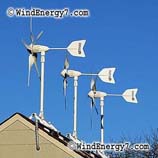
Small wind generator appliances for homes now available for everyone. These new green energy appliances are available in many sizes. Starter size kits start at just $2990 and go up from there based on your energy needs, budget, and residential requirements. As a matter of fact, the hottest selling kits are the 700w & the 1KW residential windmills. Both of these are small enough to mount on a rooftop or small tower.

Complete Wind Generator Kits:
These are complete generator head kits, hub, nose cone, blades, charge controller, & collar. Comes with everything you need to generate power by wind. These kits are put together for the Do It Yourself homeowner and are easy to put together and understand. Very well designed, high tech systems that you’ll be proud to own. These are definitely the best systems in their class.

If you are looking for a home wind system, contact us at WindEnergy7 for pricing and availability. We ship all over the US and can assist you with sales support in selecting a system and evaluating your site. Wind powered homes are here to stay and investing in a wind generator is financially a smart play. The systems pay for themselves in 7 to 10 years on average installs, often faster than that. I was researching a system for a man in North Carolina that would pay for itself in 4 to 5 years and after that, provide completely free electricity to his home.

Small Wind Turbines
residential wind power home

If you are interested in starting a wind project for your residence or acreage, contact us. To Buy a Wind Turbine or Become a Dealer, Please fill out our Contact Form. The system will automatically send you some additional info.

Wind Power Home Turbine

Sunday, September 21st, 2008

Homes across the united states are installing wind power home appliances. Like the couple in California in this video below. People are cutting their electrical bills by using clean wind power home appliances. Of course unlike the guy in this video, if you get a more economically designed system from WindEnergy7.com your cost is 1/2 to maybe 1/3 of cost of some of these other systems.

With our systems, the units pay for themselves with or without government subsidies. If you have wind resources over a zone 2, your wind system will make economical sense, paying for itself in 7 to 10 years, depending on your local situation and how large of a system you want to put in. We have done ROI studies in zone 3 to 4 that show a 5 year payback on the investment. A zone 2 is most likely 7 to 10 year payback on the investment. BUT, the system is designed to go 25 to 30 years without a rebuild. Our wind power home appliances start around $2,500 and can go as large and complex as you wish. We make sure that every customer is satisfied and the system is working for their needs.

Our wind turbines all have slip ring design. Many other turbines don’t have slip ring design, the connection cable will get twisted as the wind shifts direction and requiring constant untangling. Tangled wires can be damaged and connections can be lost with potentially disastrous consequences. Our Slip Ring design is the elegant solution to this problem. Like all other problems, you don’t have them with WindEnergy7.com turbines.

slip ring design wind turbine wind power home

WindEnergy7.com has reliable, Innovative two moving part design with 25-year maintenance-free generator life span. Can be used as either wind turbine only or wind/solar hybrid system. Integrated wind and solar power sources to capture the most energy in all conditions.  Our turbines all have very durable rotor blades. Excellent workmanship, stainless steel parts, with high strength aluminum die cast generator housing. These home wind power appliances are designed for various working conditions.  Our turbines designed for severe climate, sand and salt corrosive environments and marine usage. 

We use strong Neodymium magnet PMA, the unique winding and multi pole design reduces the start-up torque of the alternator that assures the it can generate more electricity at low wind speed than other systems. Our turbine is 400 rpm, starts charging at under 6 mph.  This unit comes with connection to easily plug-in a solar panel with plug-n-play ease.  You can use this residential turbine as a hybrid wind/solar system which will give more consistent power.  Wind is strongest in winter months, Sun/Solar is strongest in summer months.  Using our hybrid wind/solar home systems will give you more consistent power for your residence.

This starter small turbine is incredible, tested to sustain 134 mph survival speed, system operates and generate electricity up to 134 mph. The advanced speed limitation design uses electromagnetic speed limitation supplemented by aerodynamic speed limitation by blade deformation. Combination of Electromagnetic braking and aerodynamic braking maximizes energy capture by extending turbine’s operating speed range into higher speed winds and lower speed winds.

Email us.  We sell well designed, high tech systems, not just parts, plans, ideas. I could write a book on the research and design technology that goes into a little turbine like this one that WindEnergy7 sells. Our turbines are state of the art and the best there is.

residential wind power home

If you are interested in starting a wind project for your residence or acreage, contact us. To Buy a Wind Turbine or Become a Dealer, Please fill out our Contact Form. The system will automatically send you some additional info.


Wind/Solar Battleground, 8 STATES WITH NO NET METERING

Thursday, September 18th, 2008

There are actually 8 STATES WITH NO NET METERING AT ALL. To me, these should be the focus of effort… Sort of Net Metering Battleground States. See net metering map below.net metering map of us

Curiously some of these states have great wind resources along that central US belt. But even the states without much wind resources are important to home and business solar generation systems.

If your state is red, you really should be engaged in this issue. This means you have NO right or support to have your own windmill or solar and do so WITH utility power connection as well. But look how many other citizens can do this, sorry, not in your state. It’s wrong, needs fixed.

Also worth noting, look at the states that have horizontal green lines. In these states the utility buys back excess at full retail price, 1 to 1 ratio. In many states like Ohio, they bay back at about 1/2 of what the homeowner or business retail cost, so it’s 2 to 1, causing return on investment in wind or solar to take longer, thus restricts and discourages small wind/solar generation being developed and adopted. That’s what we all want and should have, equality of support for alternative energy.

We all need to support and demand that our RIGHTS be expanded to be equal to other states. If you notice by the map, about 90% of us have less opportunity for home and business wind energy than other US citizens. WHY? Because politicians have not caught onto this as a point of how they can support alternative energy.

If any of you don’t understand Net-Metering, read my tutorial on net metering.

Please contact your State’s Utility Commission, State Representatives, Congressman, Senator, and send them this link with the map here. Ask them to support the standardization of these laws and policies to equalize everyone’s ability to have economically viable investment in home and business wind/solar systems.

small wind turbnes, home, farm, school
Personal Wind Generator Systems

If you are interested in starting a wind project for your residence or acreage, contact us. To Buy a Wind Turbine or Become a Dealer, Please fill out our Contact Form. The system will automatically send you some additional info.

Power Inverters Output – Frequency 50hz vs 60hz?

Friday, September 12th, 2008

We help people with small wind generator systems all the time. When individuals start learning about the technology, they begin looking at different available components. Power inverters take DC current from a wind system anf change it to AC current for home power and home appliances to run on. The most common question that comes up is “what will happen if I get a 50 Hz inverter, the 60hz is more expensive?”  The  best answer I can give is “Dont try That at Home”  Be warned, let me inform what can happen using 50hz Asian/European inverters with US standard appliances and electrical systems.

Manufacturers build electrical devices for a certain amount of Current, Voltage and Hertz (Cycles) which is mentioned on the name plate. The Current is dependent of the Voltage and the Hertz supplied to an electric motor or appliance.

If this electrical Current running through your US appliance is higher than it is designed for, because you bought a cheap Asian/Eoropean 50hz inverter, here’s what happens. The appliance burns out, leading to premature failure, wear, and can cause a fire.

Standards for Electrical Voltage and Hertz are different in different parts of the world, roughly you can distinguish:
120 and 220 Volt; 60 Hertz (USA)
230 Volt; 50 Hertz (Europe & Asia)

What happens if you connect a 60 Hertz motor to a 50 Hertz mains:
– The motor turns 17% slower
– The internal current goes up by 17%
– The power (watt) goes down with 17 %
– The mechanical cooling is less, because of 17% less turns
– Insulation of the electrical wiring deteriorate much quicker
– Sometime results in a burn-out, which could cause a fire.pure sine wave inverter

WindEnergy7 only sells and recommends safe components that were all desined and configured to work with United States appliances and electrical standards. If you are wanting a home wind generation system, let us assist you and make as safe a system as we can.

If you are interested in starting a wind project for your residence or acreage, contact us. To Buy a Wind Turbine or Become a Dealer, Please fill out our Contact Form. The system will automatically send you some additional info.
        

Power Inverter Terminology

Tuesday, September 9th, 2008

Power Inverter Terminology

The following is a glossary of terms that may be routinely heard when shopping for equipment or reading operator’s manuals.

The Grid– Also called the utility grid, this refers to the public power distribution system.

Off Grid– Not connected to public power in any way

Sellback or Selling back to the grid– Some inverters have the capability to take energy stored in batteries or from solar panels and put it back into the utility grid. The public utility company will then pay you for using your energy. Check with the power company before attempting this.

DC– Direct Current. Electrical current that does not vary with time.

AC– Alternating Current. Electrical current that varies with time. The rate at which the voltage changes polarity is the frequency in Hertz(Hz).

Load(s)– Any electrical item which draws power. (i.e. lights, radio, washer/dryer, refrigerator, etc.)

Voltage– The pressure of electrical flow. Equivalent to water pressure in a hose.

Current(Amps)– The volume of electricity flowing through a conductor. Equivalent to gallons per unit time of water flowing through a hose.

Watts– Measure of power output or utilization. Watts=Volts x Amps

Resistance– The opposition to flow of direct current (DC)

Impedance– Opposition to flow of alternating current (AC)

Fuse or Disconnect– An electrical pressure relief valve. When current exceeds a preset limit the fuse or disconnect will fail before the wiring or equipment it is protecting. Disconnects are also called circuit breakers. These are usually resettable and can act as a switch to turn off power to equipment for servicing.

NEC code– National Electric Code. The guidelines and acceptable practices for electrical installations. It is a book published every three years.

Deep Cycle Battery– A battery designed to be routinely discharged to 20% of its maximum capacity without damage. These are the type of battery most commonly used with an inverter system.

Output Waveform– Shape of the wave that alternating current makes as its voltage rises and falls with time.

Sinewave– A waveform that looks like rolling waves on water. It rises and falls smoothly with time. The grid puts out a sine waveform. Any plug in AC equipment will operate from a sinewave output. (See graph below)

Modified Sinewave– Also called a quasi waveform or a modified sine wave. This output looks like a one step staircase. Most loads that will run from a sinewave will run from a modified sinewave. However things such as clocks and furnace controllers may have trouble. (See graph below)

Square Wave– The simplest wave form, this is shown below. Some types of equipment behave strangely when run from a square wave.(See graph below)

Islanding– The condition present when the utility power grid fails and the inverter attempts to power the grid. An inverter which is “islanding protected” senses the loss of AC power from the grid and does not back feed into the grid system.

Locked Rotor Amps– The current drawn by an electric motor with the shaft or rotor stopped and locked in position. This can be used to determine if an inverter has enough surge current to start a motor. If the inverter is capable of producing more amperage than the locked rotor amps rating of a motor, it will most likely start the motor easily.

Pass Through Current– The amount of current the inverter can safely pass directly from the AC input to the AC output.

Automatic Transfer Relay– An automatic switch that switches between inverter and charger mode depending on availability of AC input power. If AC is present the unit will be a battery charger, when AC goes away the unit becomes an inverter.

Efficiency– Usually given as a percentage, efficiency is the ratio of the output to the input. The efficiency changes with power output levels of any inverter.

Battery Equalization– Controlled “overcharging” of the battery causing it to bubble and mix. This reduces stratification.

Stratification-With time, the liquid portion of a battery (the electrolyte) will separate into layers. The sulfuric acid will go to the bottom, and the water to the top. If allowed to sit in this condition the battery will be ruined. Equalization will bubble and mix the electrolyte eliminating this problem.

LED– Light Emitting Diode. A light made up of semi-conducting material.

Line Tie– Term used when the inverter is connected to the public power or “grid” system.

Stacking– Two inverters operating together to produce more power and higher output voltage. The units must be stackable, and an interface cable must be utilized. See the manual for details on stacking if it is an option.

PV– Photo Voltaic. Solar powered.

Bulk Charge Stage– This is the first of the three stages in three stage charging. In this stage a constant current is fed to the batteries and as they accept the current the battery voltage will rise.

Absorption Stage– In this second stage of three stage charging, the batteries are held at a constant voltage (the bulk voltage setting) and the battery is charged to its maximum capacity.

Float stage– During the third stage of three stage charging, the voltage and current are reduced to a level that will trickle charge or maintenance charge the battery. This assures the battery remains fully charged even while sitting.

True RMS Digital Volt Meter (DVM)– A voltmeter that incorporates an RMS converter to read true RMS for any waveform shape.

RMS– Root Mean Square, a measure of AC voltage that would provide the equivalent heating value across a resistor as a DC source of the same voltage.


If you are interested in starting a wind project for your residence or acreage, contact us. To Buy a Wind Turbine or Become a Dealer, Please fill out our Contact Form. The system will automatically send you some additional info.

Understand Net Metering for Home Wind Turbines and Solar

Tuesday, September 9th, 2008

small wind turbine residential windmillWe get so many calls at WindEnergy7 from folks who want to install a wind system. One of the top things that customers say is, “I want to save on utility bills and and maybe make some money” So, at WindEnergy7 we try to make this happen for our customers. There are several factors to consider and calculate to see what your wind project can do, financially. Local Utility and State Net Metering policy is one factor that you have to find out about and understand.
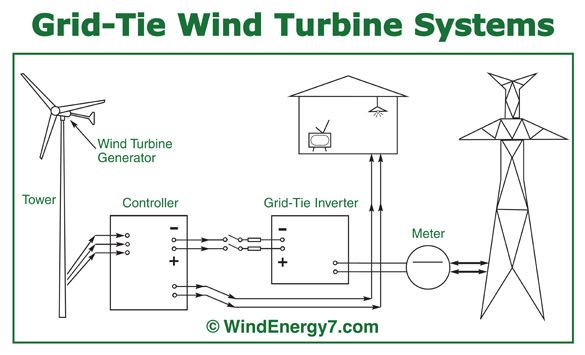
Grid-Tie or On-Grid – A term used for energy systems that are connected to the normal utility system of a home or business. With a grid-tie system your system becomes an extension of your existing utility supply. Thus if it is not running, a windmill on a still day, or a solar panel at night, you still have electricity flowing through your meter from the electrical utility, same as normal, meter running forward. In case of any downtime or maintenance of your systems you will not be without power.

RoofMill™ CLICK ON THE VIDEO BELOW TO SEE IN ACTION, INSTALL and OPERATION

RoofMill™ CLICK ON THE VIDEO ABOVE TO SEE IN ACTION, INSTALL and OPERATION

In reverse, a Grid-Tied or On-Grid system will be generating more electrical power than you use, example a windy night with all lights and household appliances are off, your meter actually running backward as you generate clean electricity to the grid that will be used by neighbors and others on the grid.

Grid-Tie-Wind-Turbine-System residential windmill

Net Metering – is the electricity policy for consumers who own wind or solar power generation systems. Net metering is the rules of your state and utility company combined. These rules vary by state AND utility provider, some better than others, thus it has much to do with the ROI (return on investment) of your system. The ideal has your existing electricity meter spinning backwards, effectively banking excess electricity production for future credit. The rules dictate if and how long you can keep your banked credits, how much the credits are worth (retail/wholesale), etc.

Net Metering is generally a consumer-based renewable energy incentive. While it is important to have Net Metering available for any consumer that interconnects their renewable generator to the grid, this form of renewable incentive places the burdens of pioneering renewable energy primarily upon fragmented consumers.

Net Metering Law – In the U.S.A., as part of the Energy Policy Act of 2005, under Sec. 1251, all public electric utilities are now required to make available upon request net metering to their customers.

‘‘(11) NET METERING.—Each electric utility shall make available upon request net metering service to any electric consumer that the electric utility serves. For purposes of this paragraph, the term ‘net metering service’ means service to an electric consumer under which electric energy generated by that electric consumer from an eligible on-site generating facility and delivered to the local distribution facilities may be used to offset electric energy provided by the electric utility to the electric consumer during the applicable billing period.

Part of the homework that a customer needs to do is:

(1) Look at their Net Metering for state and their utility company here. dsire.org

(2) Look at their bill for cost per kwH (kilowatt hour), compare to net metering information. Need to know your cost per kwH to calculate savings & ROI (return on investment).

(3) Look at their local wind map, need 11mph or better average to be successful, zone 2 or higher on DOE Wind Maps by State.

(4) Look at your site, do you have room for a turbine, usually an acre or more is best. Recently there have been urban residential installs. So, it’s possible to put one in a suburban or urban neighborhood but takes more negotiating with zoning, code enforcement and others. Most small wind turbines are put into farm-ranch lots of an acre or more.

Now, I have many customers and projects and get customers who call and just want this done easy. Many want more consultation and have questions. No problem at all, we try to provide very complete kits, information, and the service you require.

We can help you prove, plan, and execute your personal wind project or develop your wind energy plans. If you are interested in starting a wind project for your residence or acreage, contact us. To Buy a Wind Turbine or Become a Dealer, Please fill out our Contact Form. The system will automatically send you some additional info.