Reconditioned Turbine, Remanufactured Wind Turbine

July 15th, 2008

School wind projects and community wind projects are considered medium sized requirements.  So, costs are important and quick return on investment more important.

For most of these wind projects that I am working on I am quoting and recommending remanufactured & refurbished turbines for wind farms.

The question of remanufactured turbines comes up in most every new wind power project. Using the reconditioned wind turbines, or remanufactured wind turbines, the cost to fund a project and get installation are much lower and therefore makes more sense.  Frankly, it can be the difference in making a project make sense or not.

Normal Questions Asked Are:

(1) What’s difference n Remanufactured and Reconditioned Turbine?

(1) What is Projected Life of the Turbines being quoted/installed.

(2) Efficiency, we only work with best models, successful turbines.

(3) What are Operation and Maintenance Costs

(4) What is Installed Cost per Kilowatt

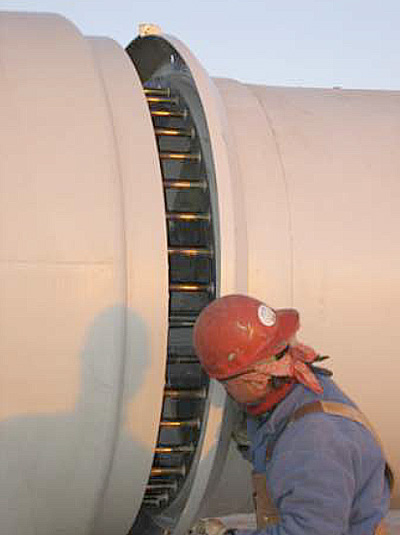
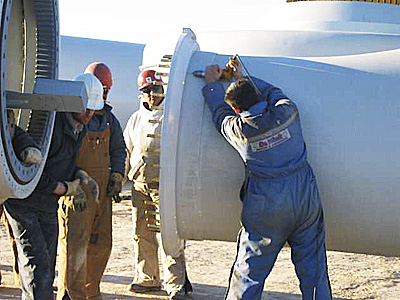
Reconditioned Turbine – a wind turbine where the condition of each of the main components are evaluated, then repaired or upgraded as needed. The turbines from WindEnergy7.com have been carefully de-installed in good working condition to make room for larger wind turbines.  This creates a nice cost effective inventory of wind turbines for smaller school and community wind projects. These turbines can be reinstalled with minimal upgrade, depending on their condition and how long it’s been since they were de-installed. Our reconditioned turbines are available for reinstall and are already reconditioned when we sell them for a community wind project.

Remanufactured Turbines – The main moving components of these turbines have been re-manufactured to new or better than new standards, very thorough. The controls, gearbox, hub, generator, hydraulic system are all thoroughly remanufactured and restored.  The most experienced turbine mechanics evaluate the condition of the remanufactured turbine.  These turbines get delivered with a full technical reporting of the remanufacturing processes and as a result, they come with warranty periods.

Used Turbines – Sometimes referred to as raw turbines.  This is a turbine sold in “as is” condition. I never recommend or get involved with the sale of a used, as-is turbine because of the risk involved.  And I carefully advise anyone, before you buy any remanufactured or reconditioned wind turbines, please allow me and my suppliers to show you what we can do, competitively before you buy reconditioned or remanufactured trbines anywhere.

Cost of remanufactured and reconditioned turbines can vary. Again, please allow WindEnergy7.com to help you out here. We really prefer to quote these as fully Installed cost.  This is better so we can be sure you are happy in the end. The installed cost includes the foundation, tower, turbine, electrical interface, wiring, engineering, program management and all components necessary to make the turbine a functioning/generating unit.  We will be glad to work with whatever team you have in place, but if you haven’t aligned all these services, let us help.

Remanufactured/Reconditioned Wind Turbines vs. New:

Remanufactured turbine cost for 40kW to 600kW class turbine, usually in range of $1,000 per kW. 

Cost of New turbines in this size/class, 40kW to 600kW, usually in the range of $1,700 per kW.

Compare to Utility sized new turbines, sizes from 1,500 kW to 3,500 kW = around $3,800 kW.

At a dramatically lower cost than the new turbine, the ROI (return on investment) of our remanufactured/reconditioned wind turbines is SO MUCH FASTER . So, your project is simply more successful as a financial endeavor, repaying loan costs at a quicker pace.

With ability to provide same warranty and have the remanufacturing or refurbishing done by the best mechanics and most experienced people i this industry, your  ongoing operation and maintenance costs will be similar.

Supply & Demand – If you have a project, or a proposed project, please email me immediately and begin discussion.  The new turbine supply is overloaded right now.  There are many manufacturers with contracts that cannot be fulfilled for a couple of years out.  Due to number of current projects, we do prefer email comminication is best, contact us at:

If you are interested in starting a wind project for your residence or acreage, contact us. To Buy a Wind Turbine or Become a Dealer, Please fill out our Contact Form. The system will automatically send you some additional info.

New Jersey – Net Metering

July 13th, 2008

New Jersey – Net Metering

Incentive Type: Net Metering

Eligible Renewable/Other Technologies: Solar Thermal Electric, Photovoltaics, Landfill Gas, Wind, Biomass, Geothermal Electric, Anaerobic Digestion, Tidal Energy, Wave Energy, Fuel Cells using Renewable Fuels

Applicable Sectors: Commercial, Industrial, Residential

Limit on System Size: 2 MW

Limit on Overall Enrollment: No limit

Treatment of Net Excess: Several options exist according to customer preference. Generally, NEG will be credited to customer’s next bill at retail rate with next excess purchased by the utility at the avoided cost rate at the end of an annualized period.

Utilities Involved: Electric distribution companies (does not apply to municipal utilities or electric co-ops)

Interconnection Standards for Net Metering?

Yes

Authority 1: N.J. Stat. § 48:3-87
Date Enacted: 1999 (subsequently amended)
Effective Date: 1999
Authority 2: N.J.A.C. 14:4-9
Date Enacted: 9/13/2004
Effective Date: 10/4/2004

Website: http://www.njcleanenergy.com

Summary:  
Note: In September 2007 the New Jersey Board of Public Utilities (BPU) approved an order regarding a redesign of the state solar-energy program. As a result, the New Jersey Office of Clean Energy (OCE) has been directed to develop modified interconnection, net metering and renewable portfolio standard (RPS) rules consistent with the program transition. Click here to view the proposed rules.  

New Jersey’s net-metering rules and interconnection standards apply to all residential, commercial, and industrial customers of the state’s investor-owned utilities (and certain competitive municipal utilities and electric cooperatives). Eligible systems include those that generate electricity using solar, wind, geothermal, wave, tidal, landfill gas or sustainable biomass resources, including fuel cells (all “Class I” technologies under the state RPS). The maximum individual system capacity is two megawatts (MW). There is no firm aggregate limit* on net metering. Many supporters of distributed generation believe that New Jersey has the best standards for net metering in the United States.  

A single metering arrangement is preferred. Customer-generators have several compensation options for net excess generation (NEG), listed below: 1. Customer-generator receives month-to-month credit for NEG at the full retail rate and is compensated for remaining NEG at the avoided-cost of wholesale power at the end of an annualized period.  

2. Customer-generator is compensated for all NEG on a real-time basis according to the PJM power pool real-time locational marginal pricing rate, adjusted for losses by the respective zone in the PJM.  

3. Customer generator may enter into a bilateral agreement with their electric supplier or service provider for the sale and purchase of NEG. Real-time crediting is permitted, subject to the applicable PJM rules.

The latter two options were added by S.B. 2936 enacted in January 2008 and effective July 11, 2008. This legislation also: (1) extends net metering to industrial and large commercial customers; (2) extends net metering to all systems that generate electricity using “Class I” renewable-energy resources; and (3) permits utilities to recover the costs of “any new net meters, upgraded net meters, system reinforcements or upgrades, and interconnection costs” through either their regulated rates or from net-metered customers. These changes are not yet reflected in the administrative rules.  

Customers eligible for net metering retain ownership of all renewable-energy credits (RECs) associated with the electricity they generate. Customers with photovoltaic (PV) systems may apply to the New Jersey Board of Public Utilities (BPU) to participate in New Jersey’s Solar Renewable Energy Certificates (S-RECs) program, which tracks and verifies solar certificates, and allows the certificates to be sold on-line to electric suppliers to meet suppliers’ solar renewable portfolio standard (RPS) requirements.  

*S.B. 2936 amended this portion of the law by removing a potential financial impact cap of $2 million and by increasing the aggregate capacity trigger to 2.5% (formerly 0.1%) of statewide peak load. As before, the BPU retains discretionary authority over capping net metering if this trigger is met.

Contact:  
Benjamin Scott Hunter
New Jersey Board of Public Utilities
Renewable Energy Program Administrator, Office of Clean Energy
44 South Clinton Avenue
P.O. Box 350
Trenton, NJ 08625-0350
Phone: (609) 777-3300 
Fax: (609) 777-3330
E-Mail: benjamin.hunter@bpu.state.nj.us
Web site: http://www.bpu.state.nj.us

If you are interested in starting a wind project for your residence or acreage, contact us. To Buy a Wind Turbine or Become a Dealer, Please fill out our Contact Form. The system will automatically send you some additional info.


Colorado – Net Metering

July 13th, 2008

Colorado – Net Metering

Incentive Type: Net Metering

Eligible Renewable/Other Technologies: Wind, Biomass, Geothermal Electric, Solar Electric, Recycled Energy, Small Hydroelectric, Fuel Cells using Renewable Fuels

Applicable Sectors: Commercial, Industrial, Residential

Limit on System Size: IOUs: 2 MW

Cooperative and municipal utilities: 10 kW for residential; 25 kW for commercial and industrial

Limit on Overall Enrollment: None

Treatment of Net Excess: Credited to customer’s next bill; IOS: utility pays customer at end of calendar year for excess kWh credits at the average hourly incremental cost for that year

Coops and Munis: annual reconciliation at a rate deemed appropriate by the utility . The annual period is undefined.

Utilities Involved: All IOUs and co-ops; munis with more than 5,000 customers

Interconnection Standards for Net Metering?
Yes. Interconnection is governed by PUC rules for IOUs and co-ops. Per HB08-1160, by 10/1/2008, the PUC must initiate a new rule making to revisit interconnection rules for co-ops. Interconnection rules for munis must be “functionally similar� to PUC rules for IOUs.

Authority 1: 4 CCR 723-3, Rule 3664
Date Enacted: 12/15/2005
Effective Date: 7/2/2006
Authority 2: C.R.S. 40-9.5-301 et seq.
Authority 3: HB 1160 of 2008
Date Enacted: 3/26/2008

Summary:  
In December 2005, the Colorado Public Utilities Commission (PUC) adopted standards for net metering and interconnection, as required by Amendment 37, a renewable-energy ballot initiative approved by Colorado voters in November 2004. The PUC standards apply to the state’s investor-owned utilities (IOUs).

Systems up to two megawatts (MW) in capacity that generate electricity using qualifying renewable-energy resources are eligible for net metering in IOU service territories. Municipal and cooperative utilities are subject to lesser maximums as described below. Electricity generated at a customer’s site can be applied toward meeting a utility’s renewable-generation requirement under Colorado’s renewable portfolio standard (RPS). The RPS mandates that 4% of the renewables requirement be met with solar energy; half of this percentage must come from solar electricity generated at customers’ facilities.

For Colorado’s net-metering rules, any customer net excess generation (NEG) in a given month is applied as a kilowatt-hour (kWh) credit to the customer’s next bill. If in a calendar year a customer’s generation exceeds consumption, the utility must reimburse the customer for the excess generation at the utility’s average hourly incremental cost for the prior 12-month period.

If a customer-generator does not own a single bi-directional meter, then the utility must provide one free of charge. Systems over 10 kilowatts (kW) in capacity require a second meter to measure the output for the counting of renewable-energy credits (RECs). Customers accepting IOU incentive payments must surrender all renewable energy credits (RECs) for the next 20 years. Cooperative and municipal utilities are free to develop their own incentive programs at their discretion but they are not subject to the solar set-aside.  

House Bill 08-1160, passed in March 2008, requires municipal utilities with more than 5,000 customers and all cooperative utilities to offer net-metering. The new law allows residential systems up to 10 kW in capacity and commercial and industrial systems up to 25 kW to be credited monthly at the retail rate for any net excess generation their systems produce. Coops and municipal utilities are free to exceed these minimum size standards if they so choose. The statute also requires the utilities to pay for any remaining net excess generation at the end of an annual period but does not define what the annual period is, nor the rate at which it will be paid. The law says that the utilities will make a payment based on a “rate deemed appropriate by the utility”. The new law also required the PUC to open a new rule making to determine if the existing interconnection standards adopted in 4 CCR 723-3, Rule 3665 should be modified for cooperative utilities. Municipal utilities are required to adopt rules “functionally similarâ€? to the existing PUC rules, but may reduce or waive any of the insurance requirements.

Contact:
Richard Mignogna
Colorado Public Utilities Commission
1560 Broadway, Suite 250
Denver, CO 80202
Phone: (303) 894-2871
E-Mail: richard.mignogna@dora.state.co.us
Web site: http://www.dora.state.co.us/PUC

If you are interested in starting a wind project for your residence or acreage, contact us. To Buy a Wind Turbine or Become a Dealer, Please fill out our Contact Form. The system will automatically send you some additional info.

Siemens Opens another Wind Turbine Plant, Illinois

July 13th, 2008

Although Siemens has recently laid off thousands of workers, that’s not an indication that wind power is not good and viable. Siemens is the largest producer of wind turbine gear drives in the United States, employing approximately 7,000 people at 40 locations throughout Illinois. Siemens’ currently runs an Elgin Illinois plant employing 150 people.green-wind-energy siemens-wind-turbine

Siemens Energy & Automation has announced that it will develop a second plant in Elgin, Illinois for the manufacturing of mechanical drives for the wind turbine industry. Siemens invested $20 million in this plant creating approximately 300 new production jobs and 55 new office jobs. A groundbreaking ceremony was held in June, 2008 and the plant is planned to be completed in the spring of 2009.

Commenting on the announcement, Anne Cooney of Siemens said that the, “new facility will enable Siemens to increase production of our mechanical drives to help our customers meet the growing demand for sustainable energy resources.”

Our congratulations to Siemens on their project and thank you for investing in US manufacturing!

If you are interested in starting a wind project for your residence or acreage, contact us. To Buy a Wind Turbine or Become a Dealer, Please fill out our Contact Form. The system will automatically send you some additional info.

Wal-Mart installs 50kw Small Wind Turbine, Attention Getter

July 12th, 2008

Wal-Mart recently unveiled a new store outside of Dallas, Texas. The store’s design combines a host of renewable energy technologies including numerous solar PV arrays, two, small wind turbines, a bio-fuel boiler to recycle and burn recovered oil from store operations and a nearly endless list of energy-saving and sustainable design principles.walmart-dallas-small-wind-turbine

The company has arranged through the Oak Ridge National Laboratory and other partners to analyze every aspect of this experiment. If successful, this will change the way Wal-Mart, designs, constructs, and manages buildings and their energy use. Usually the rest of the retail industry follows Wal-Mart’s lead on all kinds of methods, maybe this one too.

The most visible innovation can be seen from far away, serving as a fitting beacon for the experimental store: a 50 kW small wind turbine. The 146 foot tower is an eye catching attention getter that makes it stand out and get attention. A local car dealer is also inquiring, says the turbine is a great attention getter and he wants one for his car dealership that sits on the freeway. Why not?  It beats renting those large spotlights and it pays for itself, what advertisement pays for itself?  A small wind turbine…

If you are interested in starting a wind project for your car dealership, retail store, or small business, contact us. If you are interested in starting a wind project for your residence or acreage, contact us. To Buy a Wind Turbine or Become a Dealer, Please fill out our Contact Form. The system will automatically send you some additional info.

To Buy a Wind Turbine or Become a Dealer turbine@windenergy7.com.


Tour of homes features Residential Small Wind Turbine

July 12th, 2008


This pretty brown house belongs to Christine and Curt Mann may be one of the easiest houses to find on the upcoming Grant Park Candlelight Tour of Homes in Georgia. Their house is easy to spot, it’s the one with the 45-foot small wind turbine.small wind turbine residential windmill

The couple’s neighbors in this historic community tried to keep the small wind turbine from going up. But the Manns won out and erected the turbine with its three six-foot blades. Grant park Tour-goers will get to see many more energy-saving devices at the Manns’ 1920 house. The couple started reclaiming the home from the ruins last February.

The small wind turbine will offset much of the electricity bill and should pay for itself in 5 to 7 years. I addition to being a responsible thing for the environment, a turbine will run for over 30 years generating free electricity long after it’s paid for. Homeowners all over the US are putting in their own wind turbines these days.

If you are interested in starting a wind project for your residence or acreage, contact us. To Buy a Wind Turbine or Become a Dealer, Please fill out our Contact Form. The system will automatically send you some additional info.


Iowa, Eldora-New Providence School wind turbine in 2002!

July 12th, 2008

In Iowa, the Eldora-New Providence Schoolput in their 750kW NEG Micon wind turbine. The superintendent, Bill Grove reported that he expects the school to save $10,000 to $20,000 in addition to paying it’s loan payments over a 10 year loan period. As soon as the turbine is paid off, the school’s savings could increase tenfold. The turbine is expected to produce approximately 1.5 million kWh per year. Since the school uses a little less than 1 million kWh, it expects the excess power to bring income to use for educational programs.

eldora-new-province-school-wind-turbine-iowa

Others expect the project to pay for itself in approximately seven years. Analysis indicates the school can expect to earn a return on its investment of 13%. The electricity from the wind turbine is considered “inflation proof,” so if the cost of electricity rises, thus do the economic benefits from making such a smart decision.

The financing these schools receive includes some income from a federal program called the Renewable Energy Production Incentive (REPI).  The REPI was designed for incentive, so public entities that are not eligible for the federal wind energy production tax credit can still get help for wind energy. Payments from REPI are uncertain, however, because the fund relies on annual Congressional appropriations. The economics of a wind project is a great price for the electricity the turbine produces.

In most of the successful school wind projects, the local utility “net meters” the output.  With net metering, in months when the turbine produces more than the school uses, that excess value is banked with the utility to offset bills when the school needs more than the turbine produces. But, only Iowa and Ohio currently allow net metering without a size limitation on the turbine. MidAmerican Utility in Iowa has successfully applied to the Iowa Utilities Board to limit the capacity for net metering in its service territory to 500-kW, and other utilities are following suit. In lieu of net metering for large turbines, higher buy-back rates for non-profit entities could be a solution.

Six schools in Iowa have wind turbines in operation near their campuses: Sentral School in Fenton has a 65-kW Windmatic turbine, Nevada High School in Story County has one 250-kW Wind World turbine; Clay Central/Everly Community School District in Royal has a 95-kW turbine; Akron-Westfield installed a 600-kW Vestas turbine in 1999; and Clarion-Goldfield High School in Wright County installed a 50-kW AOC turbine in 2002.

If you are interested in starting a wind project for your acreage, school district, or local government, contact us at WindEnergy7.

To Buy a Wind Turbine or Become a Dealer, Please fill out our Contact Form. The system will automatically send you some additional info.

Iowa, Forest City School has Wind Turbine since 1999!

July 12th, 2008

The Forest City Community School has a 600-kilowatt wind turbine. The project was financed through a combination of a loan from the Iowa Energy Center’s Alternative Energy Revolving Loan Program and a low-interest loan from the local bank.forest-city-iowa-school-wind-turbine

Dwight Pierson, the Superintendant said “When we got started, no grant monies were available for a wind project. We understood we’d have to finance it, so we spent seven or eight months looking at the figures”. “We really felt it could pay for itself and become an asset for the district. At the time, we had one of the only turbines around that was totally financed, all through conventional loans.”

A Federal Renewable Energy Production Incentive of 1.5 cents per kilowatthour was recieved by the school. Including the incentive, the turbine has generated $284,000 (more than 4.7 million kilowatthours) worth of electricity between January 1999, when it became operational, and February 2004.

“Installing the turbine was a bold decision for our board to make,” Pierson says, “but its decision was made on good input, and the cost investment penciled out.”

At Forest City’s School it was a student who had the idea to install a wind turbine. A student in Ron Kvale’s physics class, Paul Smith, became interested in wind energy. The stdent measured the winds around the school finding that the land might be a viable site for a turbine. Smith and his teacher presented this to the school board, the board liked it. The school conducted an energy audit, that helped reduce the school’s energy use so less of the wind turbine’s electricity would be wasted.

Pierson speaks of the Forest City School wind project with pride. “This has been a win-win for our community, a real asset,” he said. “And we actually underestimated how much of an asset it would be.”

To Buy a Wind Turbine or Become a Dealer, Please fill out our Contact Form. The system will automatically send you some additional info.

Wray School District of Colorado, Wind Turbines

July 11th, 2008

/wray-colorado-school-wind-turbineOver the past five years the Wray School District has experienced countless highs and lows in the process of completing the wind turbine project.  The wind turbine is going through its final adjustments to go online.wray-colorado-school-wind-turbine

The small district spends approximately $80,000 a year on electricity. Our Wray High School Vo-Ag instructor, Jay Clapper, proposed to the district that it consider the construction of a wind turbine. This project would offset the district’s annual energy costs and provide a renewable energy educational component to the school’s curriculum.  The Board of Education agreed to support this idea, and a wind committee, including Mr. Clapper and a number of interested Wray citizens, was formed.

In December, the Wray School District Board of Education voted to approve the purchase of a 900 KW wind turbine. This project will be built on land recently purchased by the City of Wray and located south of Wray on Highway 385 near County Road JJ. The City of Wray and the Board of Education have partnered together through a power purchase agreement to see this project become a reality. It’s a Grid-Tie system, so the renewable energy captured from this wind turbine project will flow into the city grid for consumer use.wray-colorado-school-wind-turbine

When the group started the Wray School Wind Project nobody knew how complicated the process was going to be. They stuck it out, the City of Wray will have the green power generated by the turbine.  The “flip the switch” ceremony was, two months ago. Since then they’ve been troubleshooting the equipment, making final adjustments, passing mandated inspections and becoming familiar with the network of equipment and personnel that will provide technical support to this new turbine.

The blades turn evenly in the wind, but only by the perseverance of school personnel and community support does this thing work. By providing an environmentally safe source of power to this community, the visionary leaders added financial support to the education of their students. They have eased a tax burden, enhanced education, and improved their environment, that’s leadership.wray-colorado-school-wind-turbine-

wray-colorado-school-wind-turbineNow, here to the right is where it ties to the grid.  Not real dramatic is it?  I love it when a good plan comes together.  Congratulations to the Wray School District and all the great leaders who performed this project.  Nice work folks.wray-colorado-school-wind-turbine

If you are interested in starting a wind project for your residence or acreage, contact us. To Buy a Wind Turbine or Become a Dealer, Please fill out our Contact Form. The system will automatically send you some additional info.

Wind Turbine Blade Designer Needed

July 11th, 2008

We have a current need for an expert in Aerospace Engineering and aerodynamics to review and participate in the final stages of a design patent. Expertise is needed to finalize blade design of two patent protected micro wind turbines scaleable to small wind turbines and MW class.. any size. The project in its third prototype is ready for fresh perspective, input, review, and analysis.

If you are interested in this contract work and would like to get involved in a development project for wind energy, please contact us by email. If possible send a resume or overview of experience and qualifications. Will require signature of non-disclosure agreements etc.

contact us at our Email Address.

If you are interested in starting a wind project for your residence or acreage, contact us. To Buy a Wind Turbine or Become a Dealer, Please fill out our Contact Form. The system will automatically send you some additional info.